WELCOME TO WISE PILGRIM GUIDES
I make Guides for Pilgrimage, and they are available in many forms. There are analog books, apps with the same content as the books, and a separate free app called All Caminos which is a slim version meant to accompany whatever guide you like.
Thank you all for your support, and Buen Camino!
THE GUIDES ARE MOVING!
Well, technically they are already moved. In partnership with Ivar of the Camino Forums the guides now have a new home. They are faster, better organised, better looking, and will have a series of new features added in the coming months.
Navigating this site you will find that most of the content will redirect you to the new location. The new location is www.caminodesantiago.me/camino-guides.
2024 Guidebooks Shipping Now!
"All Caminos" Free App | Individual Routes | |
|---|---|---|
Accommodation | ✅ | ✅ |
City services | ✅ | ✅ |
Albergue services | ✅ | ✅ |
Distance calculator | ✅ | ✅ |
Maps | ✅ | ✅ |
Elevation profile | ✅ | ✅ |
WhatsApp Helper | ✅ | ✅ |
Historical background | ❌ | ✅ |
Trails descriptions | ❌ | ✅ |
Offline Maps | ❌ | ✅ |
Searchable | ❌ | ✅ |
The Camino Francés
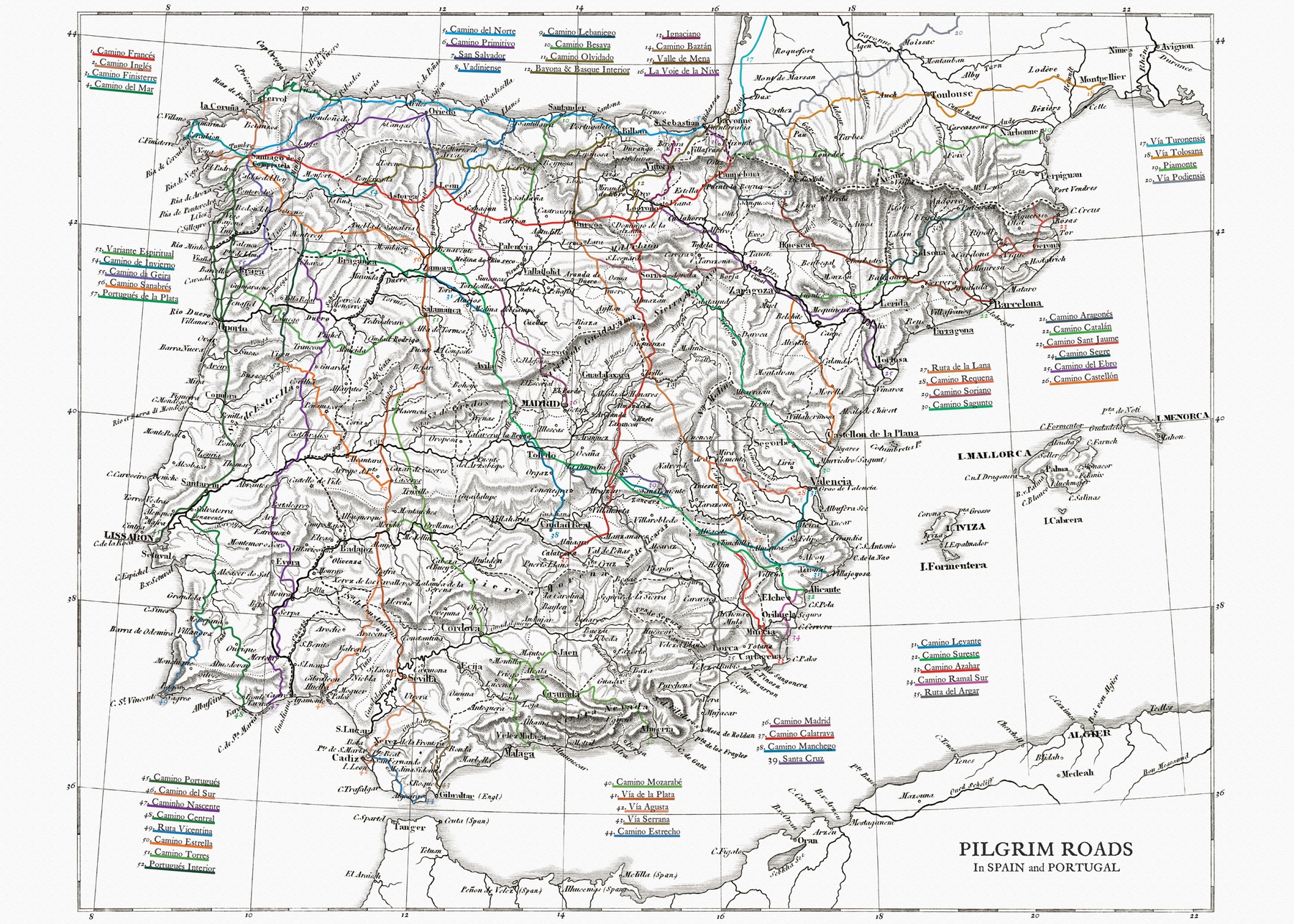
The French Way is basically the "celebrity" of all the Camino routes to Santiago de Compostela. Sporting a healthy 780 kilometers or 484 miles, it starts from Saint-Jean-Pied-de-Port in France and trots down all the way to the cathedral in Santiago de Compostela, Spain. It's like the marathon you didn't know you signed up for but now you're committed, so you might as well enjoy the ride.
As if on a grand roadshow, the Camino Francés takes you through a diverse lineup of Spain's northern regions: Navarre, La Rioja, Castile and León, and Galicia. You'll find yourself marveling at Gothic cathedrals one moment and strolling through vineyards the next, with stunning landscapes thrown in for good measure. The popularity of this route is something akin to a big blockbuster movie - it draws a crowd, especially in the summer, but the experience and the friendships you make might just be worth the hustle. Difficulty-wise, it has its own share of heart-pounding climbs and tranquil plains, a sort of roller coaster that oscillates between "why am I doing this" and "I can't believe I'm doing this." And let's not forget the cuisine. From the bold reds of La Rioja's vineyards to the tentacle-twirling delight of Galicia's pulpo, it's a gastro-journey that will make your taste buds weep with joy. The Camino Francés is not just about reaching Santiago, it's also about how many local delicacies you can sample along the way!
The Camino Portugués
More commonly known as the Portuguese Way, is like the Camino Francés's less famous, but just as attractive, sibling. Starting from Lisbon and ending at the Santiago de Compostela cathedral, the route spans about 610 kilometers or 380 miles, give or take a few detours to the nearest café. It doesn't quite garner the same crowds as its French counterpart, but its popularity has been on a slow and steady rise, much like a well-baked pastel de nata.
This scenic journey takes you through Portugal's beating heart, from the buzzing capital, Lisbon, to the university-laden city of Coimbra and onwards to the lively city of Porto, a place so beautiful that it'll have you questioning your decision to leave every step of the way. As you cross into Spain, the terrain becomes slightly more challenging, presenting a few hills here and there - just enough to make you feel like you've earned that second (or third) glass of Vinho Verde. The route as a whole is considered moderately difficult, unless you count resisting the temptation of Portuguese pastries and Galician seafood as a major challenge. With this camino, your taste buds are in for quite a pilgrimage themselves!
The Camino del Norte
The Northern Way, is a magnificent route among the Camino de Santiago paths. Its generous stretch of approximately 825 kilometers, or 513 miles, begins at the border town of Irún in the Basque Country and follows Spain's stunning northern coastline, culminating in the revered city of Santiago de Compostela. Known for its quieter, less trodden paths compared to the bustling Camino Francés, this route offers pilgrims the opportunity to truly immerse themselves in the tranquil coastal landscapes and experience a more personal, introspective journey.
This scenic path meanders through the vibrant landscapes of Basque Country, Cantabria, Asturias, and Galicia. With cultural pit stops that range from the modernist Guggenheim Museum in Bilbao to the prehistoric cave paintings in Cantabria, and a host of charming fishing villages along the way, there's never a dull moment. Brace yourself though, as the Camino del Norte is known for its moderate to high difficulty, offering a thrilling mix of climbs and descents that will keep your heart pumping and your walking sticks working overtime. As for the cuisine, it's a seafood lover's paradise, with offerings ranging from Basque pintxos to Asturian cider. Walking the Camino del Norte might just turn into a gastronomic quest, where the real goal is to sample all the coastal culinary delights before reaching Santiago de Compostela.
Camino Primitivo
The Camino Primitivo journey weaves through the breathtaking landscapes of Asturias and Galicia, immersing you in a verdant world of lush greenery, dramatic valleys, and tranquil rivers. The cultural itinerary may be less crowded but still brims with historical and charming allure. You'll follow in the footsteps of ancient pilgrims along original Roman roads and marvel at significant landmarks, such as the well-preserved Roman Wall surrounding the city of Lugo, a UNESCO World Heritage site. In terms of difficulty, think of it as a nature's bootcamp – with challenging ascents and descents that will surely give your muscles a memorable workout, balanced by stunning views that make every step worthwhile.
As for the food, your culinary pilgrimage will be as satisfying as the physical one. You'll savor the hearty Asturian fabada, a bean stew sure to refuel your energy, and the classic Galician bread and cheese. Don't miss the famed cider in Asturias, it's practically an unwritten rule of the Camino. The Camino Primitivo is a route that serves up a blend of culinary delights as diverse and rewarding as the landscapes it traverses.
The Vía de la Plata
The Silver Route holds its ground as one of the longest and most diverse routes in the Camino de Santiago network. Starting from the sunny city of Seville in southern Spain and threading its way to Santiago de Compostela, it measures up to approximately 1,000 kilometers or about 620 miles. This route is less frequented than the popular Camino Francés, making it an appealing choice for those seeking solitude and a deep-dive into Spain's historical heartland.
Spanning Andalusia, Extremadura, Castilla y León, and Galicia, the Vía de la Plata serves up a rich tapestry of cultural and geographical diversity. Imagine walking from the Moorish wonders of Seville, through the Roman ruins in Mérida, to the majestic Cathedral in Salamanca, and finally reaching the holy city of Santiago. Its difficulty level is quite high, not just because of the length but also due to some challenging terrain and the often extreme temperatures, especially in summer. Remember, though, every bead of sweat is just your body cheering you on!
When it comes to cuisine, the Vía de la Plata is a revelation. You'll be feasting on a smorgasbord of regional dishes: from the mouth-watering tapas and gazpacho in Andalusia, the succulent ham of Extremadura, to the hearty stews of Castilla y León, and the seafood delicacies in Galicia. In essence, the Vía de la Plata is a long, fulfilling journey for both your soul and your stomach.
The Camino de Invierno
The Winter Way, is an intriguing alternative to the traditional routes to Santiago de Compostela. Originating in Ponferrada and spanning approximately 265 kilometers, or about 165 miles, this pathway was initially established as a practical workaround to the often snow-clogged portions of the Camino Francés during the winter months. However, with the last 100 kilometers of the Camino Francés becoming increasingly crowded, the Camino de Invierno has been gaining popularity among pilgrims in all seasons, standing as a less congested yet equally fulfilling journey to the revered cathedral.
The route provides an intimate journey through the landscapes of Castilla y León and Galicia, with an array of valleys, mountains, vineyards, and rivers to mesmerize the intrepid traveler. On the cultural side, the Camino de Invierno doesn't skimp on offerings either; you'll experience historical riches including medieval bridges, Roman mines, and rustic hamlets seemingly untouched by time. As for difficulty, the terrain is varied and moderately challenging, with a good mix of ascents and descents to keep things interesting. It might make you contemplate why you didn't stick to the treadmill at the gym, but the views will quickly remind you why.
Food-wise, prepare for a gastronomic adventure that celebrates the humble and hearty cuisine of rural Spain. As you meander through the vineyards of Ribeira Sacra, the wine will flow almost as freely as the camaraderie. From Castilian roast lamb to Galician octopus, each region will introduce you to its own culinary tradition, making the Camino de Invierno a pilgrimage for your palate as well as your spirit.
The Camino San Salvador
The Way of San Salvador, is a unique and compact route in the Camino de Santiago family. This trail, stretching over about 120 kilometers, or 75 miles, runs from León to Oviedo. Despite its shorter length, it doesn't skimp on offering a rich and memorable experience, and has been gaining recognition among pilgrims who wish for a brief but enriching journey, or those seeking an extension to their Camino Francés by connecting it with the Camino Primitivo.
The route takes you through Castilla y León and Asturias, providing a microcosm of the region's diverse landscapes, from the fertile plains of León to the rugged mountains of Asturias. The cultural itinerary includes the magnificent Gothic Cathedral of León and the historic city of Oviedo, known for its Pre-Romanesque architecture. Despite its shorter distance, don't underestimate its difficulty. The route includes a fair bit of mountain trekking which will test your stamina, but reward you with awe-inspiring views.
As for cuisine, the Camino San Salvador offers a sampling of the region's gastronomic delights, such as the hearty Cocido Lebanieg' stew in León and the famous Asturian cider in Oviedo. From mountain peaks to delicious eats, the Camino San Salvador promises an unforgettable journey packed into its relatively modest mileage.
Finisterre & Múxia
online guide
Santiago to Hospital
Hospital to Finisterre
Hospital to Múxia
Finisterre to Muxía
The Camino to Finisterre and Muxía
Often referred to as the "Camino Finisterre," is a unique route that starts, rather than ends, in Santiago de Compostela. This path, stretching approximately 120 kilometers or about 75 miles to Finisterre, and an additional 29 kilometers or 18 miles to Muxía, is an attractive option for those who feel their journey isn't quite complete at Santiago and yearn to reach what was once considered the end of the known world.
The journey predominantly passes through the rural landscapes of Galicia, brimming with eucalyptus forests, serene farmland, and charming villages. The last leg of the journey, particularly, is marked by stunning views of the Atlantic coastline. From a cultural perspective, the destination itself, Finisterre, is steeped in ancient lore, with its legendary "end of the world" status and the iconic lighthouse. Adding the trip to Muxía allows pilgrims to visit the Sanctuary of A Virxe da Barca, a site of a religious miracle according to local belief.
In terms of difficulty, the route is relatively moderate but with some hilly areas that will give your legs a good workout. As for the cuisine, expect to enjoy some of Galicia's finest seafood, with delicacies such as pulpo a la gallega (Galician-style octopus) and empanadas, coupled with the region's crisp white Albariño wine. Walking from Santiago to Finisterre and Muxía is like a beautiful encore to the Camino de Santiago, a path that insists the journey is just as important, if not more so, than the destination.
The Camino Nascente
The Caminho Nascente in Portugal is a captivating journey through the country's heartland, offering a rich tapestry of food, history, and natural beauty. Beginning in the Algarve and stretching over 600 km to the medieval town of Trancoso in the Beira region, this route takes pilgrims through the Alentejo and Beiras regions, showcasing Portugal's diverse landscapes and cultural heritage.
Food along the Caminho Nascente is deeply rooted in local traditions, with the Alentejo region being particularly renowned for its agricultural products such as cork, olive oil, and a unique style of wine-making known as "vinho a talha". The camino's passage through areas like the Cova da Beira is also notable for its seasonal abundance of cherries, a sweet highlight for pilgrims traversing this route in spring.
Historically, the Caminho Nascente is dotted with imposing castles, medieval gates, and Manueline doorways, reflecting Portugal's rich past. From the fortifications of Castro Marim to the towers of Trancoso, pilgrims encounter a wealth of historical sites. Esteemed landmarks include the Portas de Ródão, an imposing natural gateway formed by rocky mountains along the Tejo River, offering breathtaking views and a tangible sense of history with medieval castle ruins to explore.
The journey also leads through Évora, a UNESCO World Heritage site, with its well-preserved Roman temple, numerous churches, and the haunting Capela dos Ossos. Each town and village along the way, from Alvito to Estremoz, tells its own story, often linked to Portugal's age of exploration and battles for independence, offering a deep dive into the country's historical narrative.
Accommodations vary, with modern albergues less common, but the tradition of welcoming pilgrims remains alive through various community lodgings and historic hotels, such as the pousada in Alvito's 15th-century castle, providing a unique opportunity to stay in historically significant properties.
The Caminho Nascente is not just a pilgrimage but a journey through Portugal's living history and rich culinary traditions, set against a backdrop of stunning landscapes that shift from the citrus groves of the Algarve to the golden wheat fields of the Alentejo and the greenery of the Beiras.
The Caminho Nascente
online guide
In Algarve
In Baixo Alentejo
In Alto Alentejo
In Beira Baixa
In Beira Alta
The Camino Olvidado
The Forgotten Way, is an off-the-beaten-path Camino de Santiago route that begins in the vibrant city of Bilbao. This roughly 625 kilometers or 388 miles long trail invites pilgrims to a less crowded and authentically Spanish journey, culminating in Ponferrada. From there, you have the choice to merge with the bustling Camino Francés or continue along the lesser-traveled Camino de Invierno, both leading to Santiago de Compostela. It's the perfect route for those seeking a quieter path with the freedom to join the main route or continue on a less frequented trail.
This path unveils a vivid canvas of Spain's diverse regions, including the Basque Country, Cantabria, Castilla y León, and parts of Galicia if you choose the Camino de Invierno. You'll journey through dramatic mountain ranges, lush valleys, and charming, rural landscapes. Along the way, you'll discover rich cultural sites from medieval churches and bridges to picturesque, timeless villages. Despite some challenging inclines and declines, the Camino Olvidado is more than manageable for those with a zest for adventure.
Culinary explorations are a staple on this route, with regional cuisines from the Basque's seafood specialities, Cantabria's hearty mountain food, to the delightful cocido lebaniego stew of Castilla y León. The Camino Olvidado, true to its name, presents an unforgettable journey that captivates both your spirit of adventure and love for gastronomic delights.
The Camino Inglés
The English Way, is one of the shortest yet historically rich routes to Santiago de Compostela. Spanning a mere 119 kilometers or about 74 miles, this route starts from the port city of Ferrol and traverses the heart of Galicia. As the name suggests, it was historically the preferred route of English and Irish pilgrims who arrived by boat to the northern Spanish ports and is now a popular choice for those with limited time or those seeking a shorter pilgrimage.
The Camino Inglés takes you through the verdant landscapes of Galicia, abundant with eucalyptus and pine forests, rolling hills, and traditional hamlets. The cultural highlights include the medieval quarters of Pontedeume and Betanzos, both of which house architectural treasures such as gothic churches and historic palaces. The trail offers a moderate level of difficulty with several steep ascents and descents, but nothing that would make a determined pilgrim bat an eye.
When it comes to food, the Camino Inglés will make your taste buds dance the flamenco. Galician cuisine dominates the menu with a smorgasbord of seafood, empanada gallega (a local savory pie), pimientos de padrón (fried green peppers), and the comforting caldo gallego (Galician broth). Wash it all down with a glass (or two) of the region's famous Albariño wine, and you've got a gastronomic pilgrimage to remember. The Camino Inglés might be short, but it packs in a beautiful blend of history, culture, and cuisine, giving you a taste of the Camino experience in a condensed form.
caminho da geira e dos arrieiros
Sometimes referred to as the Via Romana XIX, is a unique route in the Camino de Santiago network. This relatively new pathway, which stretches for approximately 240 kilometers, or about 150 miles, from Braga in Portugal to Santiago de Compostela in Spain, has been gaining attention as a tranquil alternative to the more bustling routes, perfect for those in search of solitude and historical richness.
The Camino da Geira unfolds through the Minho region in Portugal and Galicia in Spain, offering a picturesque blend of rolling countryside, dense forests, and pristine rivers. The route has a notable historical significance as it traces the ancient Roman road known as Via Nova, where milestones marking the Roman route can still be found along the way. The walk is moderately challenging, with several inclines and rougher paths that require good physical preparation. However, your efforts are rewarded with the tranquil beauty of the landscapes and the spiritual satisfaction of following in ancient footsteps.
The culinary journey along the Camino da Geira is just as fulfilling as the physical one. It offers a delightful exploration of Minho and Galician cuisine. You can indulge in 'vinho verde' and hearty 'caldo verde' soup in Minho, and enjoy the famous seafood, cheeses, and crisp Albariño wine in Galicia. The Camino da Geira, thus, serves up an experience that's rich in history, beauty, and gastronomy, making it a journey well worth considering.
WALL MAPS